UK Scaffolding Industry Insight
The Scaffold Supply Side of the UK Industry: How It Works, What Is Broken and What Comes Next
The UK scaffolding industry is often viewed from the outside as a service industry: scaffolders arrive on site, erect access, inspect it and eventually dismantle it. Behind every scaffold, however, sits a substantial and highly fragmented supply chain involving tube, fittings, boards, system scaffold, netting, PPE, tools, vehicles, plant, transport and specialist services.
For contractors, the ability to source the right equipment at the right time can have a direct impact on whether a project starts on programme, whether margins are protected and whether expensive equipment sits idle in the yard. Yet much of the way scaffold equipment is still bought, sold and redistributed remains surprisingly traditional.
How the Scaffold Supply Chain Works
Scaffold contractors sit at the centre of a much wider ecosystem than is immediately obvious.
A typical scaffolding business may purchase directly from manufacturers, national distributors, regional scaffold merchants, PPE suppliers, tool companies, vehicle dealers and other scaffold contractors.
The supply chain might look something like this:
But that is only part of the picture.
Equipment also moves horizontally between contractors.
A contractor that has finished a major project may suddenly have thousands of tubes, boards or system components returned to its yard. Another scaffolder ten miles away may simultaneously be buying exactly the same equipment new because they do not know the surplus stock exists.
That disconnect is one of the most interesting inefficiencies within the industry's supply side.
What Do Scaffolding Contractors Actually Buy?
Scaffold procurement goes far beyond tube and boards.
Core Scaffold Equipment
- Scaffold tube in multiple lengths
- Scaffold boards
- Double couplers
- Swivel couplers
- Sleeve couplers
- Putlog couplers
- Base plates
- Adjustable base jacks
- Ladders
- Ladder gates
- Hop-up brackets
- Gin wheels
- Scaffold beams
- Loading bay equipment
- Stair towers
- System scaffolding components
Protection and Containment
- Debris netting
- Scaffold sheeting
- Monarflex-type sheeting
- Shrink wrap
- Brick guards
- Fans and protection decks
- Debris containment systems
Tools and PPE
- Scaffold spanners
- Impact wrenches
- Podgers
- Levels
- Tape measures
- Tool belts
- Harnesses
- Lanyards
- Safety helmets
- Gloves
- Safety boots
- High-visibility clothing
Vehicles and Yard Equipment
- Scaffold lorries
- Dropside trucks
- Flatbeds
- Pickups
- Trailers
- Forklifts
- Telehandlers
- Stillages
- Racking systems
- Yard handling equipment
The result is that even a relatively small scaffolding company can maintain relationships with numerous different suppliers.
The Different Types of Scaffold Supplier
There is no single type of company serving the scaffolding sector.
Manufacturers
Manufacturers produce scaffold systems, components, boards, fittings, access equipment and specialist products. Larger contractors may deal directly with manufacturers, particularly when purchasing significant quantities.
National Distributors
National distributors hold large volumes of equipment and can supply contractors across multiple regions. They often become preferred suppliers for larger scaffolding companies requiring consistency and volume.
Regional Scaffold Merchants
Local and regional merchants remain extremely important. Scaffolders frequently value the ability to collect equipment quickly, speak directly to somebody they know and source a small quantity without organising national delivery.
Specialist Suppliers
A scaffold contractor may use entirely different suppliers for netting, PPE, tools, signage, workwear, temporary roofing products or fall protection.
Other Scaffolding Contractors
The industry itself is also a major source of equipment.
Scaffolders regularly buy and sell equipment between themselves, particularly when businesses are:
- Downsizing
- Upgrading equipment
- Changing scaffold systems
- Clearing yard space
- Finishing major projects
- Closing or restructuring
How Scaffolders Currently Procure Equipment
The buying process varies enormously depending on the contractor.
A small scaffolder might simply notice that the yard is running short of boards and telephone their usual supplier.
A larger contractor may have a dedicated yard manager, procurement team or stock-control process.
Common procurement methods still include:
- Telephone orders
- Supplier websites
- WhatsApp messages
- Trade contacts
- Facebook groups
- Online classified listings
- Used-equipment dealers
- Direct manufacturer relationships
None of these methods is inherently wrong. In fact, personal relationships remain a valuable part of construction procurement.
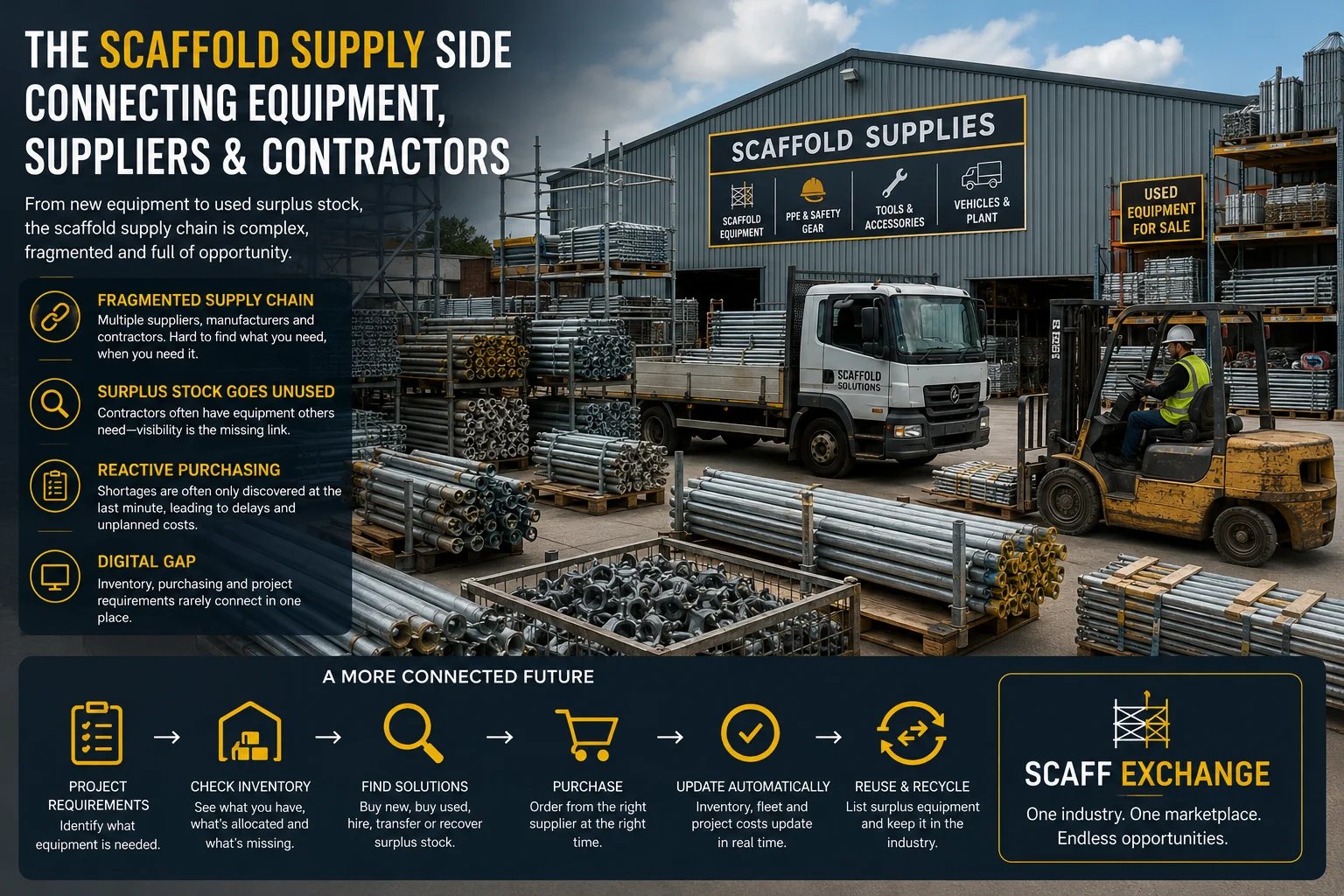
The problem is that the information is fragmented.
Equipment availability may exist in one place, contractor demand in another and actual stock requirements somewhere else entirely.
The Second-Hand Scaffold Equipment Market Is More Important Than It Looks
Scaffold equipment has an unusually strong second-hand market because much of the core equipment is reusable for years when properly maintained and inspected.
Tube, boards, fittings, beams, system scaffold, stillages, ladders, vehicles and yard equipment can all retain meaningful residual value.
This creates an active secondary economy.
A contractor might have:
800 surplus 13ft boards sitting in a yard in Yorkshire while another contractor 20 miles away is about to order 500 new boards.
In theory, that is a highly efficient local transaction waiting to happen.
In reality, the two companies may never know about each other.
Used equipment is typically discovered through contacts, social media, dealers, classifieds or word of mouth.
That works, but it is not particularly efficient.
What Is Broken in Scaffold Supply?
1. Procurement Is Fragmented
Scaffolders may need to visit or contact several different suppliers simply to source everything required for one project.
Tube may come from one business, netting from another, PPE from another and tools from somewhere else.
The industry does not currently have a natural central purchasing environment covering the broad range of products scaffolders actually use.
2. Stock Requirements Are Often Reactive
Purchasing frequently happens once somebody realises there is a shortage.
A gang might be loading for tomorrow's job before discovering that the required number of boards, fittings or ladders are not available.
That can result in:
- Last-minute purchasing
- Expensive delivery
- Job delays
- Gang downtime
- Unnecessary stock purchases
3. Supply and Demand Are Not Connected
One contractor can have excess equipment while another has a shortage.
There is currently little infrastructure connecting those two pieces of information automatically.
4. Used Equipment Is Difficult to Search Properly
Used scaffold equipment listings are often inconsistent.
Product descriptions vary, quantities are unclear, condition is subjective and buyers may have to search through unrelated listings.
A specialist marketplace structure could make equipment significantly easier to categorise.
5. Supplier Discovery Is Still Relationship Driven
Scaffolders often repeatedly use the same suppliers because they know them rather than because they have visibility of every available option.
Loyalty is valuable, but it also means a strong independent regional supplier may struggle to reach scaffold contractors outside its existing customer network.
6. Purchasing Is Disconnected From Job Costing
Even when equipment is purchased digitally, it may not automatically connect with the job that created the requirement.
This makes it harder to understand the real cost of particular contracts.
7. Asset Records Are Often Separate
A scaffolding company may buy a vehicle, forklift or significant quantity of equipment and then manually enter that information into a completely separate fleet, accounting or inventory system.
That duplication is unnecessary.
The Biggest Missing Link: Inventory and Procurement
Perhaps the most important opportunity lies in connecting scaffold inventory directly with purchasing.
Consider a contractor that has a major project commencing next week.
Project Equipment Requirement
Required boards: 480
Available: 350
Already allocated elsewhere: 70
Actual available stock: 280
Shortfall: 200 boards
In many businesses today, somebody has to identify that shortage manually.
A connected system could recognise it weeks in advance.
It could then allow the business to decide whether to:
- Purchase new equipment
- Purchase used equipment
- Hire equipment
- Move stock from another yard
- Recover equipment from another project
That transforms procurement from a reactive process into a planned one.
Why Local Scaffold Suppliers Still Matter
Digitalisation should not mean removing local suppliers from the process.
In fact, better technology could make local scaffold suppliers more competitive.
Location matters considerably when dealing with heavy scaffold equipment.
Saving a small amount on the price of tube may be irrelevant if transport costs significantly more or delivery takes several extra days.
Scaffold procurement therefore needs to take into account:
- Distance
- Stock availability
- Delivery speed
- Collection options
- Trade relationships
- Bulk pricing
- Reliability
- Product quality
The future is unlikely to be simply "show the cheapest supplier".
It is more likely to be:
Find the most appropriate supplier for this particular requirement.
The Digital Gap in Scaffold Procurement
Construction software has advanced rapidly in areas such as project management, accounting, fleet tracking and health and safety.
Procurement within many specialist trades has not advanced at the same pace.
The scaffold sector still lacks a truly connected digital environment where:
- A contractor knows what equipment it owns
- The system knows what upcoming projects require
- Shortages are identified automatically
- Suppliers can expose available stock
- Used equipment can be listed easily
- Purchases update inventory automatically
- Sales remove stock automatically
- Vehicles move directly into the fleet register
- Purchases can be connected to project costs
Individually, none of those functions is revolutionary.
The opportunity comes from connecting them.
Why Supplier Competition Should Not Become a Race to the Bottom
Any attempt to bring multiple suppliers into one environment must avoid creating a marketplace based solely on price.
Scaffold procurement is more nuanced than buying a commodity from the cheapest website.
A supplier offering next-day delivery from 12 miles away may be considerably more valuable than a supplier that is 3% cheaper but cannot deliver for five days.
Future scaffold procurement platforms therefore need to consider:
- Price
- Delivery
- Availability
- Distance
- Supplier reputation
- Existing account relationships
- Trade pricing
- Order history
Scaffolders should still be able to maintain preferred suppliers while having access to alternatives when necessary.
There Is Also an Opportunity for Suppliers
Much of the discussion around procurement understandably focuses on contractors, but a more connected market could be equally valuable to suppliers.
Smaller scaffold suppliers often have excellent products and competitive pricing but limited digital reach.
They may not have the SEO budget, advertising spend or e-commerce infrastructure required to compete with larger national distributors online.
A specialist scaffold marketplace could potentially put those companies directly in front of contractors already looking for their products.
Rather than asking a local supplier to compete for a Google search such as:
"scaffold netting suppliers UK"
their products could appear when a scaffolding contractor actually has a live requirement for netting.
That is a very different type of customer acquisition.
Vehicles, Plant and Equipment Need to Be Part of the Conversation
The scaffold supply economy extends well beyond materials.
Scaffold lorries, pickups, forklifts, telehandlers, trailers and yard equipment represent significant capital expenditure.
These assets also change hands regularly within the sector.
A contractor replacing a scaffold lorry could theoretically list it directly from its fleet register, including:
- Make and model
- Registration year
- Mileage
- MOT information
- Service history
- Payload
- Photographs
- Maintenance records
A buyer could then purchase the vehicle and immediately add it to its own fleet management system.
Again, the value comes from removing duplicate administration.
What About Consumables?
Large equipment purchases create significant transaction values, but everyday consumables may ultimately create the strongest purchasing habit.
Contractors repeatedly need:
- Gloves
- PPE
- Netting
- Sheeting
- Tags
- Signs
- Tools
- Batteries
- Workwear
- Fixings
These are comparatively small purchases but they occur frequently.
A contractor that becomes accustomed to checking one industry marketplace first for routine purchases is much more likely to return when it later needs £20,000 worth of equipment.
What Is Missing Today?
The UK does not lack scaffold suppliers.
It does not lack good manufacturers.
It does not lack used equipment.
It does not lack demand.
What appears to be missing is the layer connecting all of those things together.
The issue is not necessarily supply. It is visibility, integration and timing.
The right equipment often already exists somewhere.
The challenge is knowing:
- Who has it?
- Where is it?
- What condition is it in?
- How quickly can it arrive?
- Is buying it the best option?
What Could the Future of Scaffold Procurement Look Like?
Imagine a scaffolding contractor pricing a new project.
The scaffold design and take-off identify the likely equipment requirement.
The company's inventory is checked automatically.
The system identifies a shortage.
Upcoming Project
Equipment shortage detected:
- 86 scaffold boards
- 24 × 21ft tubes
- 40 double couplers
- 300m² debris netting
The contractor could then see:
- New stock available from approved suppliers
- Used equipment available locally
- Equipment available for hire
- Stock available at another company location
Once purchased, the equipment would automatically become part of the contractor's inventory.
When it is eventually surplus, it could potentially be listed for sale again.
That begins to create a circular equipment economy rather than a simple one-way purchasing process.
Could the Industry Benefit From a Scaffold Exchange?
There may ultimately be an opportunity for something broader than another scaffold supplies website.
A genuine scaffold exchange could bring together professional suppliers, manufacturers, used-equipment dealers and scaffolding contractors within the same specialist environment.
New equipment could sit alongside used equipment.
A regional PPE supplier could sit alongside a national scaffold distributor.
A contractor clearing 1,000 boards from its yard could reach another contractor actively looking for those boards.
Vehicles, plant, tools and specialist scaffold products could all exist within the same industry ecosystem.
The key difference would be integration.
Rather than simply browsing adverts, scaffold businesses could eventually source equipment in response to actual operational requirements.
That concept is beginning to emerge through platforms such as Scaff Exchange, where the aim is not to replace existing scaffold suppliers, but to make the wider supply market easier for contractors to navigate.
If successful, the most useful version of a scaffold marketplace will probably not be the one offering the lowest price.
It will be the one that saves the contractor the most time.
The Bigger Opportunity: A More Connected Scaffolding Industry
Scaffolding is already a substantial UK industry, but much of its supply infrastructure remains highly fragmented.
That fragmentation has survived because contractors, suppliers and manufacturers have built strong relationships and developed ways of working around it.
Technology does not need to remove those relationships.
It can make them easier to access.
The next generation of scaffold procurement could combine:
- Local suppliers
- National distributors
- Manufacturers
- Used equipment
- Contractor surplus stock
- Vehicles
- Plant
- PPE
- Tools
- Digital inventory
- Live project requirements
Put those pieces together and scaffold procurement starts becoming less about searching across multiple websites and making numerous phone calls, and more about simply knowing what is needed and where it can be sourced.
That may be where the real opportunity on the supply side of the scaffolding industry lies.
Frequently Asked Questions
Where do UK scaffolders buy scaffold equipment?
UK scaffold contractors commonly purchase equipment from manufacturers, national distributors, independent regional scaffold suppliers, specialist access suppliers and other scaffolding contractors selling used equipment.
Do scaffolders buy used scaffold equipment?
Yes. There is a significant second-hand market for scaffold tube, boards, fittings, beams, system scaffold, stillages, vehicles and yard equipment. Much of this equipment can remain usable for long periods when correctly maintained and inspected.
What do scaffolding companies buy regularly?
In addition to major scaffold equipment purchases, contractors regularly buy PPE, gloves, netting, sheeting, scaffold tags, signs, tools, workwear, fittings and replacement boards.
Why would scaffolders use an industry marketplace?
A specialist marketplace can reduce the need to search numerous suppliers independently. It could also help contractors discover local suppliers, used equipment and surplus stock that they may otherwise never know is available.
What is a scaffold exchange?
A scaffold exchange is a specialist marketplace concept connecting scaffolding contractors with suppliers and other contractors buying and selling industry equipment. It can potentially include new equipment, used equipment, PPE, tools, vehicles, plant and specialist services.