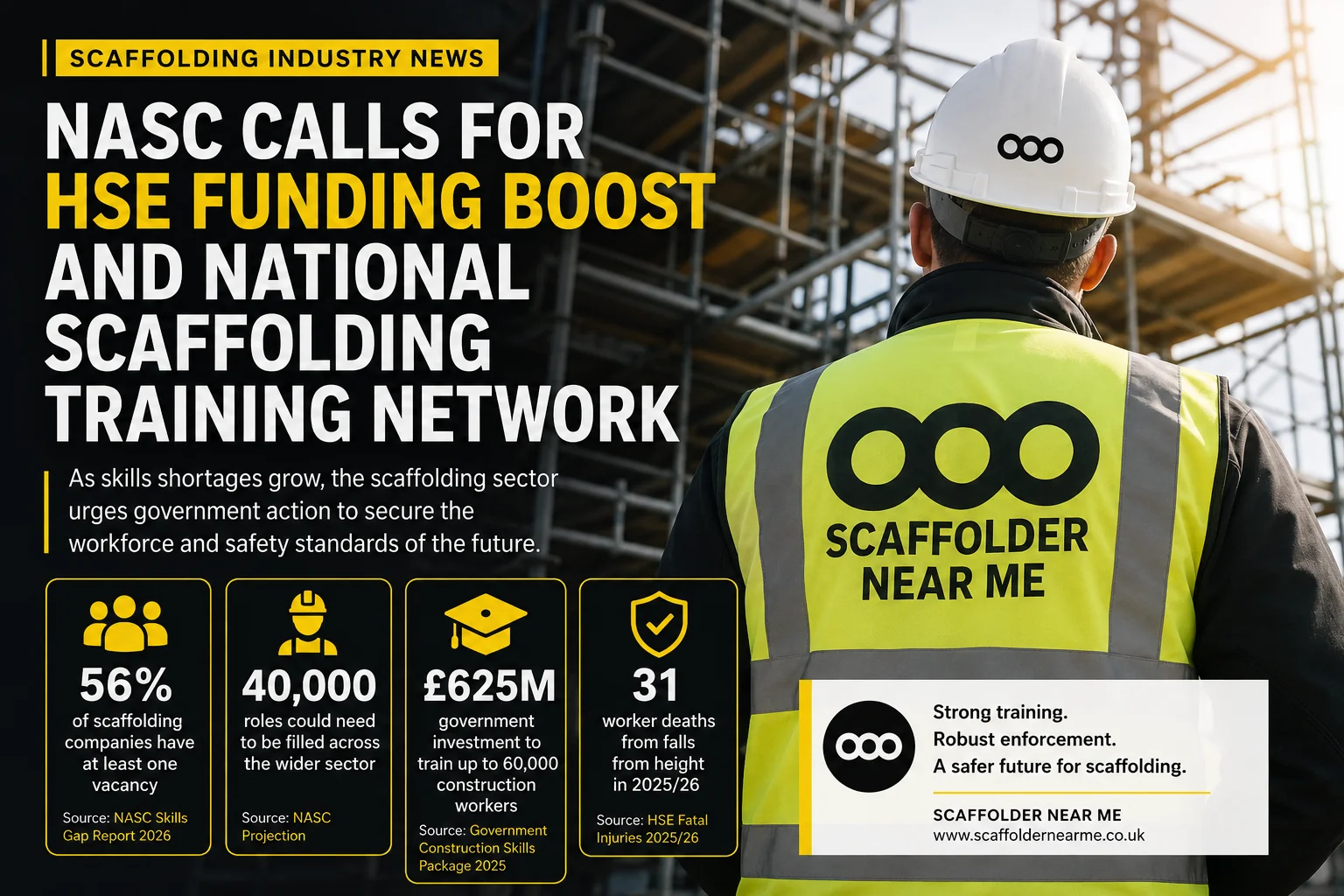
Scaffolding Skills Shortage: NASC Calls for HSE Funding Boost and a National Training Network
The UK scaffolding sector faces a difficult balancing act: recruit and train thousands more skilled workers while maintaining the safety and competence standards expected from an industry built around working at height.
NASC's updated 2026 Manifesto is calling for increased HSE funding, stronger investment in construction skills and the development of a nationwide scaffolding training network. The proposals arrive as NASC estimates the wider scaffolding sector could need to fill the equivalent of around 40,000 roles when recruitment demand, retirement and workforce turnover are considered.
The National Access & Scaffolding Confederation (NASC) has set out a series of proposals aimed at strengthening the UK's scaffolding and access sector, including increased funding for the Health and Safety Executive, greater investment in further education and a coordinated national scaffolding training network.
The recommendations form part of NASC's updated 2026 Manifesto, which covers safety, skills, employment, supply chains, training and transport. NASC says its members contribute almost £3 billion in added value to the UK economy while providing temporary access and structures across construction, infrastructure, transport, energy, manufacturing and other industries.[1]
For the thousands of businesses operating across the sector — including the scaffolding companies listed in our UK directory — the central issue is increasingly clear: Britain needs more scaffolders, but increasing workforce numbers cannot come at the expense of competence.
A scaffolding workforce shortage that is becoming difficult to ignore
NASC's 2026 Skills Gap Report provides one of the clearest pictures yet of the recruitment challenge facing professional scaffolding businesses.
NASC reported that 83% of responding companies expected to recruit during 2026, while scaffolders represented the largest individual category of current vacancies.[2]
The problem extends beyond simply finding someone willing to work. Scaffolding requires structured training, practical experience, supervision and recognised competence. An inexperienced worker cannot simply be placed into the role of an experienced scaffolder because there is a vacancy to fill.
A labour shortage does not only affect recruitment teams. It can restrict the number of contracts a scaffolding company can accept, increase overtime, put pressure on existing gangs and ultimately increase the cost and availability of scaffolding for contractors and customers.
The rest of UK construction is competing for workers too
Scaffolding businesses are not recruiting in isolation.
CITB's Construction Workforce Outlook 2026–2030 estimates that UK construction will require an average of around 41,200 additional workers every year over the five-year forecast period.
That equates to approximately 206,000 additional workers by 2030, reflecting construction growth as well as the need to replace workers leaving the industry.[3]
That competition becomes particularly important when government investment begins creating additional demand for construction workers in housebuilding, infrastructure, energy and retrofit.
Why NASC wants a national scaffolding training network
The UK already has CISRS-accredited training centres, but availability is not necessarily uniform.
The CISRS training centre directory shows that different centres offer different combinations of COTS, Part 1, Part 2, Advanced Scaffolder, inspection, supervisor, system scaffold and apprenticeship training.[4]
This means the nearest training centre to an employer may not necessarily offer the stage or type of training that employee needs.
NASC is therefore calling for a more coordinated nationwide approach involving government, the education sector and CISRS training providers.
The ambition should arguably be greater than simply increasing the number of training locations. A useful national strategy would need to consider where scaffolding demand exists, where shortages are most severe and where apprentices and existing workers currently have difficulty accessing training.
A stronger network could include:
- More geographically accessible Part 1, Part 2 and Advanced training.
- Better regional mapping of scaffolding skills shortages.
- More structured routes for 16–18-year-olds entering the industry.
- Closer links between training centres and local scaffolding employers.
- Greater apprenticeship capacity.
- Clear progression from trainee through to advanced scaffolder and supervisor.
- Better awareness of scaffolding as a skilled long-term career.
- Funding that smaller companies can realistically access.
The training challenge is not just about finding a course
For many smaller scaffolding businesses, the cost of training extends well beyond the course fee itself.
Employers may also have to absorb wages, travel, accommodation and the loss of productive site time while an operative is completing training.
NASC has previously highlighted the gap between the cost of core scaffolder training courses and the grants available to employers. CITB funding continues to provide achievement grants for core CISRS pathways, including Part 1, Part 2 and Advanced Scaffolder training.[5]
Training capacity
Enough places must exist in the parts of the UK where scaffolders and employers actually need them.
Employer affordability
Small contractors still need to release employees from productive work and meet costs that are not necessarily covered by grants.
Increasing the number of courses without addressing both problems would only provide part of the solution.
Government is already putting hundreds of millions into construction skills
There is a potentially significant opportunity for scaffolding within the government's broader construction skills programme.
Government funding now includes a £625 million Construction Skills Package intended to help deliver up to 60,000 additional skilled construction workers.[6]
The question for scaffolding is how much of that investment ultimately reaches specialist access trades.
A recognised national scaffolding training strategy could give the sector a much stronger case when regional and national construction training investment is being allocated.
Why NASC is simultaneously asking for more HSE funding
Rapid workforce growth creates another challenge: ensuring that training and safety enforcement keep pace.
NASC's manifesto specifically calls for increased funding for the Health and Safety Executive and greater public awareness of safe, compliant scaffolding.[1]
The latest HSE statistics demonstrate why work at height remains such an important issue.
HSE recorded 126 worker fatalities in 2025/26, including 25 deaths within construction. Falls from height accounted for 31 worker deaths, making them the most common type of fatal workplace accident during the year.[7]
Those numbers extend well beyond scaffolding itself, but they underline the environment in which scaffolding companies operate.
Scaffold inspections remain a fundamental part of the safety system
Competence does not finish once a scaffold has been erected.
Inspection, handover and ongoing management remain an essential part of keeping access structures safe throughout a project.
Customers and contractors using Scaffolder Near Me can specifically find companies offering scaffold inspections and should establish inspection requirements before work begins.
For commercial projects, documentation can also be important. Our guide to scaffold handover certificates explains how handover documentation can form part of the process between erection and use.
NASC members are reporting historically strong safety performance
The safety picture is not entirely negative.
NASC's 2026 Safety Report recorded zero operative fatalities among NASC contractor members during 2025.
Across a workforce of 20,168 operatives, NASC members reported 82 RIDDOR-reportable accidents, producing an Accident Incident Rate of 4.07 and an Accident Frequency Rate of 0.21.[8]
NASC calculated this as approximately one reportable incident for every 470,000 operative working hours.
Why enforcement still matters
Strong safety performance among responsible contractors does not remove the need for enforcement.
Companies investing in training, insurance, competent supervision, inspection and compliant scaffold design carry costs that less responsible operators may try to avoid.
Effective enforcement therefore has two functions: protecting workers and creating a fairer commercial environment for companies that invest in doing the job correctly.
The real challenge is growing the workforce without lowering the bar
If demand continues to grow, there will inevitably be pressure to bring new workers into scaffolding more quickly.
The wrong response would be to weaken competence requirements simply to increase workforce numbers.
A more sustainable model combines:
- Greater training capacity.
- Better financial support for employers.
- More apprentices and new entrants.
- Clearer career progression.
- Strong CISRS competence standards.
- Effective HSE oversight and enforcement.
- Better understanding of compliant scaffolding among customers.
What does this mean for customers hiring scaffolding?
Workforce shortages may feel like an industry issue, but they can have a direct impact on homeowners, builders, roofers and principal contractors.
Reduced labour availability can affect lead times, availability and pricing, particularly during periods of high construction demand.
Customers should therefore avoid selecting a contractor purely because they have offered the lowest figure.
When evaluating a scaffold quote, consider the company's insurance, experience, relevant competence, availability, inspection arrangements and exactly what is included in the hire.
Our guide to comparing local scaffold prices explains some of the factors worth checking before appointing a company.
What could happen next?
NASC's updated approach means its manifesto is intended to evolve rather than remain a static document.
The organisation says its ESG and Public Affairs Committee will continue updating priorities as government policy and industry conditions change.[1]
The important question is now whether the scaffolding sector can secure a meaningful share of wider construction skills investment and convert that funding into training capacity where it is actually needed.
If that can be achieved alongside stronger safety enforcement, better careers education and clearer routes into CISRS training, the industry has an opportunity to tackle its workforce shortage without compromising the standards on which professional scaffolding depends.
The bigger picture for UK scaffolding
Scaffolding is often one of the first specialist trades required on a construction project and one of the last to leave.
Housing, roofing, infrastructure, industrial maintenance, refurbishment, energy projects and commercial construction all depend on safe temporary access.
A shortage of competent scaffolders therefore has consequences well beyond scaffolding businesses themselves.
The NASC proposals highlight an issue that is likely to become increasingly important over the coming years: how does Britain increase construction capacity without allowing safety and competence to fall behind?
For scaffolding, the answer increasingly appears to be a combination of better training access, greater employer support, strong industry standards and effective regulation.
Frequently asked questions
Is there currently a shortage of scaffolders in the UK?
NASC's 2026 Skills Gap Report identified significant recruitment pressure among its members and estimated that the wider sector could potentially need to fill around 40,000 roles once vacancies, workforce turnover and retirement are considered.
What is NASC asking the Government to do?
Its updated manifesto includes calls for stronger construction training provision, improved careers education, greater support for employers, increased HSE funding and development of a more coordinated scaffolding training network.
What is CISRS?
CISRS is the Construction Industry Scaffolders Record Scheme and provides recognised training and competence pathways for scaffolding operatives, supervisors and inspectors.
Why is HSE funding relevant to scaffolding?
Scaffolding involves work at height and safety-critical temporary structures. Effective inspection, guidance and enforcement help protect workers while helping prevent non-compliant operators from gaining an unfair commercial advantage.
How can I find a scaffolder in my area?
You can browse scaffolders across the UK or post your scaffolding job once and allow companies covering your postcode to respond.
Sources & further reading
- National Access & Scaffolding Confederation — Updated NASC 2026 Manifesto, published 24 August 2026.
- National Access & Scaffolding Confederation — NASC Skills Gap Report 2026.
- Construction Industry Training Board — Construction Workforce Outlook 2026–2030.
- Construction Industry Scaffolders Record Scheme — UK CISRS Training Centre Directory.
- NASC / CITB — CISRS training and CITB grant guidance, 2026.
- Skills England / UK Government — Construction Skills Package and Annual Skills Report 2026.
- Health and Safety Executive — Work-related fatal injuries in Great Britain 2025/26.
- National Access & Scaffolding Confederation — Safety Report 2026, covering member accident data for 2025.
Need scaffolding for a project?
Find scaffolding companies covering your postcode or post your job once and let suitable local scaffolders respond with quotes and site visit options.