Can Scaffolding Go on My Neighbour's Property?
Sometimes the only practical way to repair a roof, chimney, wall or gutter is to put part of the scaffold in the neighbour's garden. But needing access and having a legal right to it are not always the same thing. This guide explains permission, access orders, party wall rights, overhanging scaffold and what happens if your neighbour simply says no.
There are situations where a legal right of access may exist — most notably certain works covered by the Party Wall etc. Act 1996 or where a court grants an access order under the Access to Neighbouring Land Act 1992. But those are specific legal routes, not a general licence to put scaffolding wherever it is convenient.
The issue usually arises in terraced and semi-detached properties where the boundary sits very close to the building. A roof may be entirely yours, yet the safest place to stand the scaffold might be six feet into next door's garden.
That is where the distinction between owning the building and having access to someone else's land becomes important.
“Does the scaffold actually cross the property boundary — either at ground level or above it?”
You control your own land, subject to any existing rights, covenants or other restrictions.
Simply needing their land for easier access does not automatically give you the right to use it.
What if the scaffold is completely on my own property?
If the entire scaffold structure remains within your boundary and no part of it enters or overhangs your neighbour's land, neighbour access permission will not normally be required simply because the scaffold is close to the boundary.
That does not mean other rules disappear. The scaffold still needs to be properly designed, erected by competent people and inspected as required.
You also need to consider whether ties, ladders, netting, sheeting or working activities will actually cross the boundary even if the scaffold standards themselves do not.
What if the scaffold doesn't touch their garden but hangs over it?
This catches people out.
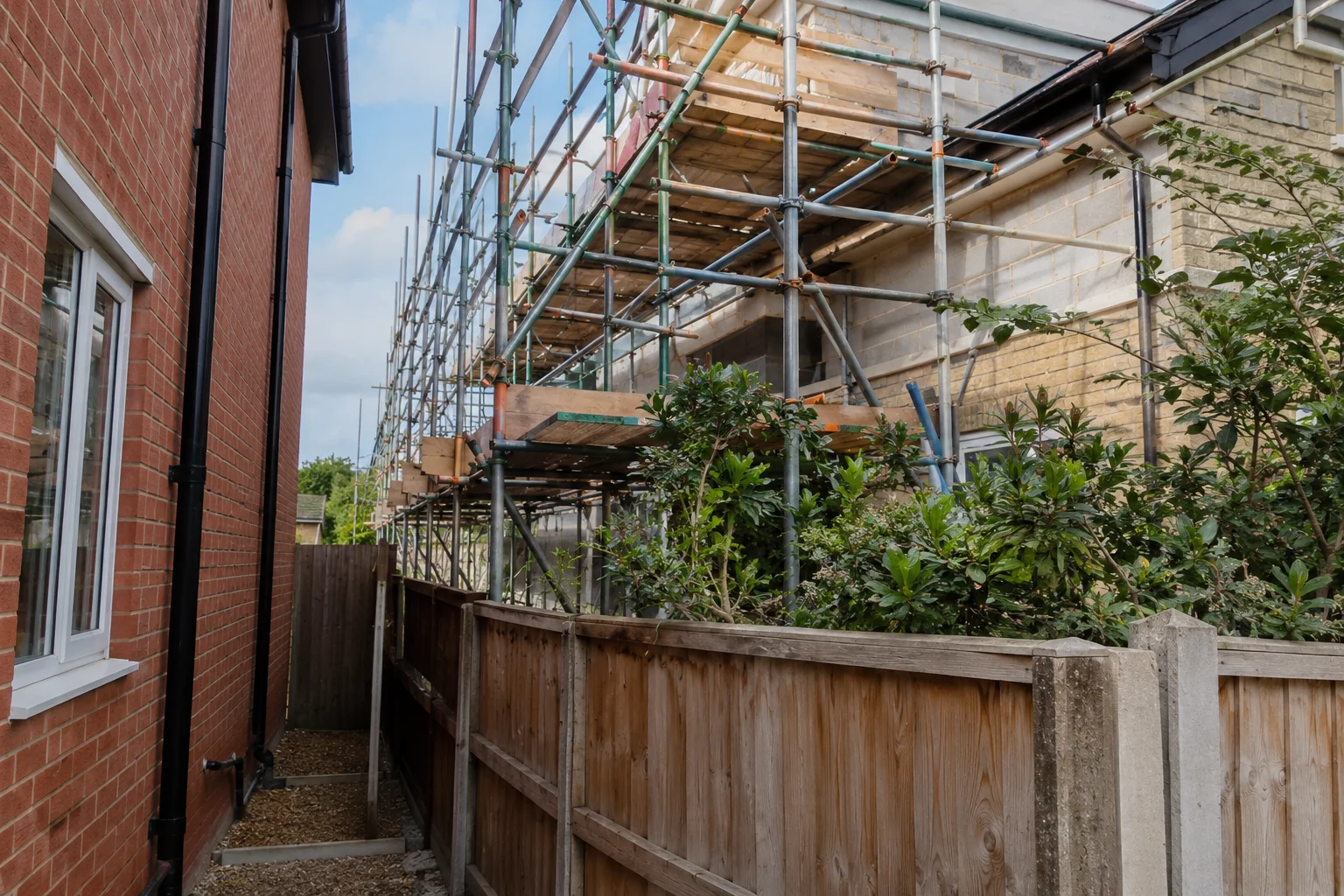
A scaffold can be physically based on your property while tubes, platforms or other components project across the boundary into the airspace above your neighbour's land.
You should not assume that this is acceptable simply because no scaffold standard is touching their lawn.
Property rights can extend into the usable airspace above land, and construction projects that need to enter neighbouring airspace commonly use an oversailing or access licence.
Practical rule: if any permanent or temporary part of the scaffold crosses the boundary, get the position agreed before erection.
Four situations that look similar but are legally very different
Roof repairs to an existing house
Scaffold needs to stand in the neighbour's gardenYour roof is leaking and the rear elevation can realistically only be accessed by putting scaffold standards on neighbouring land.
A new extension
Scaffold access would make construction easierYou are constructing a new extension right up to the boundary and want the builder to place scaffolding in the neighbour's garden.
Party wall work
Access is necessary to execute works under the ActThe project involves work covered by the Party Wall etc. Act 1996 and access to the adjoining property is genuinely required to carry out those works.
Scaffold overhangs the boundary
Nothing touches the neighbour's groundThe standards are within your garden, but a working platform, transom or other section projects over the neighbour's property.
Always start with permission, not legislation
Most domestic scaffold-access problems never need to reach a solicitor or court.
A neighbour is far more likely to agree when they understand:
- why access is actually required;
- exactly where the scaffold will stand;
- how long it will remain;
- who the scaffolding company is;
- how their garden or property will be protected;
- how scaffold security will be managed;
- what insurance is in place; and
- that any damage will be made good.
Turning up with a scaffolding lorry on Monday morning and telling the neighbour that the scaffolders “only need a little bit of your garden” is one of the fastest ways to turn a straightforward request into a dispute.
Put the access agreement in writing
For anything more than trivial access, a simple written access or scaffold licence can protect both sides.
Useful points to agree before erection
Can my neighbour refuse to let me put scaffolding on their land?
In many circumstances, yes.
Owning a house does not generally give you unrestricted rights to use adjoining private property simply because doing so would make your building work easier.
The position changes where a specific legal right applies.
Essential preservation work
Repairs or maintenance genuinely required to preserve an existing building may potentially qualify for an access order where the work cannot reasonably be carried out, or would be substantially more difficult, without neighbouring access.
Improvement or development
Wanting to build a larger extension, create something new or make construction cheaper and easier does not automatically create the same access right.
The Access to Neighbouring Land Act 1992
For properties in England and Wales, the Access to Neighbouring Land Act 1992 provides a potential court route where access to neighbouring land is required to carry out preservation work.
The court can make an access order where it is satisfied that the work is reasonably necessary for the preservation of the relevant property and that it cannot be carried out, or would be substantially more difficult to carry out, without entering the neighbouring land.
The Act specifically recognises examples of basic preservation work including:
- maintenance of a building or structure;
- repair of a building or structure;
- renewal of parts of a building or structure;
- certain drain, sewer, pipe and cable works;
- certain works involving dangerous or damaged trees and hedges;
- certain ditch clearance or filling works.
This can potentially include the access needed to erect scaffolding where that scaffold is reasonably necessary to carry out the permitted preservation work.
The 1992 Act does not mean you can simply walk into the garden
This is an important distinction.
If the neighbour refuses permission, the legislation provides a route to ask the court for an access order.
It should not be read as permission to ignore the neighbour, unlock the gate and erect scaffolding anyway.
Do not confuse a potential right to obtain access with an existing right to take access however and whenever you choose.
What can a court include in an access order?
An access order can be quite detailed.
Rather than simply saying “the neighbour must allow access”, it can specify matters such as:
- the works that may be carried out;
- the exact area of neighbouring land that may be entered;
- the dates or period during which access is permitted;
- working hours;
- who may enter the land;
- precautions that must be taken;
- insurance requirements;
- a photographic or other record of the condition of the land;
- compensation for qualifying loss, damage or inconvenience; and
- requirements to remove waste and make good the property afterwards.
The court can also refuse an order where the interference, disturbance or hardship to the neighbouring owner or occupier would be so serious that granting access would be unreasonable.
What happens if the neighbour still refuses access?
Ask informally
Explain the work, scaffold location and proposed dates.
Put the request in writing
Provide the relevant drawings, scaffold footprint and contractor information.
Try to agree protections
Working hours, security, garden protection, insurance and making-good provisions can often resolve the objection.
Take property-law advice
Establish whether the proposed work genuinely falls within a statutory access route.
Apply for an access order where appropriate
Claims under the Access to Neighbouring Land Act follow a court procedure and should not be treated as an informal notice.
What if the Party Wall etc. Act 1996 applies?
This is a separate route and causes a lot of confusion.
The Party Wall etc. Act applies to certain works involving party walls, boundary structures and excavations near neighbouring buildings in England and Wales.
Where works are genuinely being carried out under the Act, the legislation provides rights of entry onto adjoining land for the purpose of executing those works.
In normal circumstances, the adjoining owner and occupier must receive 14 days' notice of the intended entry.
The building owner must also avoid unnecessary inconvenience and can be responsible for loss or damage resulting from works carried out under the Act.
The important limitation: the Party Wall Act is not a universal “scaffolding access law”. The access right relates to work being executed under that Act. It should not be used as justification for unrelated building work.
But I have planning permission. Doesn't that give me access?
No.
Planning permission and private property rights are separate matters.
A council can approve your extension without giving you ownership or access rights over the garden or airspace next door.
The same principle applies where works are permitted development.
If your construction method requires neighbouring land, the private access position still needs to be dealt with.
Can my neighbour charge me for having scaffolding on their land?
If you are simply asking the neighbour to grant a private scaffold licence voluntarily, they may ask for a payment in return for agreeing to temporary use of their property.
There is no universal domestic “scaffold access fee”. The amount, if any, is something that can be negotiated as part of the licence.
The position under a court-ordered access route is more technical.
An Access to Neighbouring Land Act order can require compensation for matters such as loss, damage, injury or substantial inconvenience. The Act also contains provisions relating to payment for the privilege of access, but specifically restricts that form of consideration where the relevant works are to residential land.
This is one of the areas where individual legal advice is sensible if meaningful sums of money are being requested.
Who pays if the scaffold damages the neighbour's garden?
This should be agreed before erection rather than argued about afterwards.
Typical concerns include:
- cracked paving;
- damaged lawns;
- broken fence panels;
- damaged flower beds;
- damage to render or brickwork;
- scratched conservatory roofs;
- blocked access;
- damage caused during erection or dismantling.
Take dated photographs before the scaffold is erected and make the responsibility for making good clear in the written access agreement.
Your scaffolder should also have appropriate insurance for the work they are undertaking.
Don't overlook security
A scaffold can create a route to first-floor windows, flat roofs, balconies and adjoining properties that did not previously exist.
This becomes especially important where scaffold is erected partly on neighbouring property.
The scaffold plan should consider:
- unauthorised climbing;
- ladder access;
- children gaining access;
- access to windows and roofs;
- out-of-hours security;
- lighting;
- fencing or barriers where appropriate.
The fact that the neighbour agreed to the scaffold does not mean they agreed to unreasonable additional security risk.
What if the scaffold is on the pavement rather than the neighbour's land?
That is a different permission system.
Scaffolding that occupies or encroaches onto a public highway — including a pavement — requires the appropriate licence from the local highway authority.
The builder or scaffolding contractor is responsible for obtaining the scaffold licence, while the customer should check that the licence is in place and remains valid for the duration of the work.
A pavement licence does not give permission to occupy a neighbour's private garden, just as a neighbour's permission does not replace a highway licence.
What if it's my neighbour who wants scaffolding on my property?
Turn the question around and the same principles apply.
It is reasonable to ask:
- What work are they carrying out?
- Why does the scaffold need to be on my property?
- Exactly where will it stand?
- How long will it remain?
- Who is the scaffolding contractor?
- What insurance do they hold?
- How will my garden or driveway be protected?
- Who is responsible for making good damage?
- What security measures will be provided?
- Will anyone need access through my house or garden?
You do not have to treat every request as hostile, but you also do not need to agree to an undefined arrangement with no dates, protections or responsibility for damage.
Scaffolding on neighbouring land: quick guide
| Situation | Likely position |
|---|---|
| Scaffold entirely inside your boundary | Neighbour's land permission is generally not required simply because the scaffold is close to the boundary. |
| Scaffold physically stands on neighbour's land | Obtain permission unless a specific statutory or court-authorised access right applies. |
| Scaffold oversails neighbour's land | Treat neighbouring airspace as a property-right issue and obtain an appropriate agreement. |
| Essential repairs cannot realistically be completed otherwise | Access to Neighbouring Land Act 1992 may potentially provide a court route in England and Wales. |
| Party Wall Act works require access | Statutory access rights may apply, subject to the Act and relevant notice. |
| New extension merely easier to build from next door | Do not assume preservation-work access rights apply. Negotiate access or obtain legal advice. |
| Scaffold stands on public pavement | A separate highway scaffold licence is normally required. |
The sensible way to arrange neighbour scaffold access
For most domestic projects the best process is surprisingly simple:
- Ask your scaffolder to confirm exactly how much neighbouring land is required.
- Get a simple scaffold drawing or marked photograph showing the proposed footprint.
- Speak to the neighbour before booking the erection date.
- Explain why the scaffold is required and how long it is expected to remain.
- Agree access, protection, working hours and security.
- Take photographs of the neighbour's property before work starts.
- Put the agreement in writing.
- Make sure the scaffolder knows the exact restrictions before arriving on site.
- Remove the scaffold promptly when the project is complete.
- Make good any agreed damage immediately.
That is considerably cheaper and less stressful than allowing a boundary disagreement to turn into litigation.
Need scaffolding near a boundary?
Describe your property and access requirements once and receive quotes from scaffolders who cover your postcode.
Frequently asked questions
Can scaffolding be put on my neighbour's property?
Yes, but you should normally have the neighbour's permission before using their land. Specific statutory rights may apply in limited situations, including certain Party Wall Act works or where a court grants access for qualifying preservation works.
Can my neighbour refuse scaffolding?
In many situations they can refuse voluntary access. However, where access is genuinely necessary for qualifying preservation works, an application for an access order may potentially be available in England and Wales. Certain Party Wall Act works also carry separate access rights.
Can I put scaffolding on my neighbour's land for roof repairs?
Ask permission first. Where roof repairs are reasonably necessary to preserve the property and the works cannot be carried out, or would be substantially more difficult, without neighbouring access, the Access to Neighbouring Land Act 1992 may potentially provide a route to seek a court order.
Does planning permission allow scaffolding on neighbouring land?
No. Planning permission deals with planning law and does not normally override private property rights. Separate permission or another lawful right of access may still be required.
Can scaffolding overhang my neighbour's garden?
Do not assume that overhanging is permitted simply because the scaffold does not touch the neighbour's ground. Temporary structures entering neighbouring airspace can interfere with property rights, so appropriate consent or an access agreement should be obtained.
Can a neighbour charge for scaffolding access?
A neighbour voluntarily granting a private scaffold licence may request a fee as part of the agreement. Court-ordered access is governed by different statutory rules, including provisions relating to compensation, inconvenience, damage and residential land.
Who is responsible if scaffolding damages my neighbour's property?
Responsibility depends on the circumstances, agreements and the party that caused the damage. A written access agreement should clearly address protection, insurance and making good. Taking photographs before erection is also sensible.
Does the Party Wall Act let me put scaffolding next door?
The Party Wall etc. Act 1996 contains access rights where entry is required to execute works under the Act. It is not a general right to use neighbouring land for unrelated construction. Normal notice requirements apply.
Do the same rules apply in Scotland?
No. The Party Wall etc. Act 1996 and Access to Neighbouring Land Act 1992 framework discussed in this guide applies to England and Wales. Property and access law differs in Scotland and Northern Ireland, so local legal advice should be obtained.